Saturday, 25 June 2016

Arik Air sponsors conjoined twins on surgery trip

L-R: Diana Ekpenyong, Events & Sponsorships Coordinator Arik Air; Adebanji Ola, PR & Communications Manager Arik Air; Ayeni Samuel Olusegun, Father of conjoined twins, Mother of Conjoined twins Mrs. Ayeni Mary Abiodun; Efe Farinre, Founder Linking Hands Foundation and Jide Alade, Associate Vice President Marketing and Communications, Arik Air during the presentation of return tickets to New York for conjoined twins, Miracle and Testimony Ayeni at Lagos State University Teaching Hospital, Ikeja over the weekend.
In a feat to lighten the financial burden on the shoulders of a Nigerian parent, Arik Air has shown care and concern to support their conjoined twins on a surgery trip to New York. According to the airline, “ Arik Air, West and Central Africa’s largest airline has sponsored the return tickets to New York for conjoined twins, Miracle and Testimony Ayeni in order for the twins to have immediate access to medical care and surgery that they require.
The airline is offering this support in partnership with Linking Hands Foundation, a non-governmental organisation which has secured free medical treatment for the twins at 
Le Bonheur Children’s Hospital, Memphis, Tennessee, USA.
Arik Air will be sponsoring the twins as the airline’s own little way of not only ensuring that the Ayeni twins get needed medical treatment speedily but also to assist the family in reducing some of the financial burden associated with this trip.”
The Founder of Linking Hands Foundation, Efe Farinre while thanking Arik Air for accepting to fly the twins and their family said Miracle and Testimony Ayeni were born on 16th November, 2015, at St. Patrick Hospital Enugu, to Mr Samuel Olusegun Ayeni and Mrs Mary Abiodun Ayeni, both of Kogi State, Nigeria. The twin girls who are conjoined in the pelvic region were taken to The University of Nigeria Teaching Hospital (UNTH), Enugu immediately after delivery. They were moved to Lagos State University Teaching Hospital (LASUTH) on 22nd April and have been under medical supervision.
“We are grateful to Arik Air for linking hands with us to give Miracle and Testimony Ayeni the opportunity to have individual lives. Through this invaluable support, Arik Air has given the twins a chance to live and yet again demonstrated leadership in corporate social responsibility”, said Farinre.
Arik Air’s Chief Commercial Officer, Suraj Sundaram commented: “Arik Air has been committed to the community since its inception having contributed to various charitable activities through a number of events, programs and initiatives. In this instance, our support will enable these twins access to specialized medical care and give them an opportunity to build a healthy and productive future they deserve.”


Thursday, 23 June 2016

EXPLOITING THE ECONOMIC POTENTIALS OF THE NIGERIAN AVIATION INDUSTRY


 By Yakubu Dati


The aviation industry is a catalyst for socio-economic development anywhere! It provides the fastest and safest means of transportation of persons and cargo within and between countries thereby promoting commerce and industry, two of the major determinants of the Gross Domestic Product. 

Tourism, which today, constitutes the economic mainstay of such countries as UAE and Ethiopian, is given impetus by air transportation. This perhaps, explains the prominence occupied by Emirates and Ethiopian airlines in the economies of these two countries. And you are tempted to ask, what can any economy do without aviation?

The administration of President Muhammed Buhari has shown, by its recent pronouncements and policies on the aviation industry, that it is ready to exploit the economic potentials of the industry, to stimulate growth in the country’s economy. In his presentation at the last interactive forum with aviation stakeholders in Abuja, the Minister of State, Aviation, Senator Hadi Sirika, acknowledge that “aviation is pivotal to growth of key economic sectors, certainly not limited to travel and tourism, agricultural production and distribution, rural development, trade and commerce, manufacturing, oil and other non-oil sectors.”

He added that aviation “is that critical tool necessary for economic transformation of any nation. Indeed, the value chain creation by aviation is enormous”. Simply put, the President Muhammadu Buhari administration is well aware of the economic potentials of the aviation industry, its present challenges and how to adequately tackle these challenges, with a mind to making the best of these potentials in the overall interest of the country. 

According to Senator Sirika, “the present administration is focusing on issues that will rapidly develop the aviation sector within the shortest possible time”. He highlighted the challenges of the industry and Government’s response to them. On global and national security threats from terrorism, he said that Government had begun a comprehensive security threat and vulnerability assessment, development of a new security strategy in partnership with international security organization and procurement of modern, state of the art equipment. These are in addition to the commencement of an airport certification programme and manpower capacity development.

Another major policy thrust of this administration is the concession of the four major international airports in Lagos, Port – Harcourt, Abuja and Kano, after infrastructure upgrade to address the recurring challenge of obsolete airport infrastructure and inadequate capacity. This administration is also poised to establish a national carrier in order to gain optimal benefits from BASA/MASA and minimise capital flight, among other things. The absence of a major maintenance repair and overhaul facility in West and Central Africa which is responsible for high cost of aircraft maintenance for Nigerian airlines has necessitated the setting up of a world class MRO facility that will attract clientele from other parts of the world. The MRO, when established will further be encouraged to start manufacturing aircraft parts.  

The Federal Government will also facilitate the completion of agro-allied and cargo terminals at designated airports across the country. This move is expected to enhance the country’s foreign exchange earnings, apart from discouraging rural-urban migration and encouraging massive rural development. A major milestone of this administration in the industry is the establishment of an aviation university that would “specifically produce the needed workforce for better efficiency” and curb the absence of high level management staff and research capabilities in the aviation industry.

This Government also intends to establish an Aviation Leasing Company, the first of its type in the country, in order to address the challenges of limited access to capital, high debt profile, inadequate number of aircraft in the fleet of local airlines and high cost of leasing. Government also intends to establish an Aviation Development Bank to enable industry entrepreneurs get long term funding at reasonable interest rates, among other things. In that presentation, Senator Sirika also hinted that the Ministry of Transportation was working with the Central Bank of Nigeria, the Ministry of Budget and National Planning and the Ministry of Finance to include local airlines in the priority list of foreign exchange allocation. He also promised that Government would sustain the policy of granting duty waivers to local airlines for the importation of aircraft and aircraft spares which he said had “contributed immensely to the survival of (local) airlines”. 

These policies of the present administration, when fully implemented, have the potential of further unlocking the economic potentials of the country’s aviation industry, making it more “profitable, self-sustaining and beneficial to all stakeholders” according to the Minister. 

A sign of what to expect in the industry in future is indicated in the achievements recorded by this administration in the last one year. The flagship of Nigerian airports, the Murtala Muhammed Airport and Nnamdi Azikiwe International Airport, Abuja passed a recent ICAO security audit with 96 per cent, apart from Nigeria passing the ICAO Universal Safety Oversight Audit. Within this period, operation in the control tower at MAKIA, Kano was automated while bomb containment vessels were provided at the Kano and Port-Harcourt Airports, among other numerous achievements.

Yakubu Dati
General Manager, Public Affairs, Federal Airports Authority of Nigeria  (FAAN)

AFCAC trains Aviation Safety Inspectors


The African Civil Aviation Commission, AFCAC and Civil Aviation Authority of Singapore, CAAS just concluded the training of some Aviation Safety Inspectors in Africa countries hosted by the Nigerian Civil Aviation Authority, NCAA.
According to Sam Adurogboye, General Manager, Public Relations to NCAA, “The Nigerian Civil Aviation Authority (NCAA) has played host to the pilot edition of Safety Oversight Inspectors Course (Aerodrome) in Lagos, Nigeria.
This Aerodrome course hitherto offered in Singapore Civil Aviation Academy was taken to diaspora for the very first time in its existence. The first offshore location for the course away from Singapore was at the NCAA Conference Facility, Lagos, Nigeria.
In cognizance of importance of the course to global aviation safety, 40 participants from 15 African countries were in attendance for this maiden edition.”
Nigeria provided the highest number of participants. There were 13 (nos) from the Nigerian Civil Aviation Authority (NCAA) and three from the Federal Airports Authority of Nigeria (FAAN).
In addition, 14 (nos) other countries were similarly in attendance. They were Burkina- Faso, Cameroon, Niger Republic, Congo, Mali, Cote de voire, Togo, Senegal, Chad, Egypt, Kenya, Uganda, Gambia and Sierra Leone.
The five-day Course was organized by the African Civil Aviation Commission (AFCAC) in collaboration with the Civil Aviation Authority of Singapore (CAAS).The training has as its focus vital areas of Aerodrome Oversight functions.
Some of  which includes overview of the states’ Safety Oversight Obligations, Critical Elements of Safety System, Safety Management System(SMS), Airport Emergency Planning, Operational Services  and Maintenance Practices, physical characteristics(runways, taxiways, clearways, stop ways and holding bays).
Others are, visual aids for navigation, indicators and signaling devices, markings, lights, signs and markers, Aerodrome operational service, equipment and installations,  rescue and fire-fighting, training programme (review, records and documentation),  training of apron drivers, runway incursion prevention, wildlife and foreign object damage management inter alia.
 During the closing ceremony, the Director General, NCAA Capt.Muhtar Usman informed the Aviation Safety Inspectors (ASI) that the essence of the course was to enhance their Safety oversight management capacity of aerodromes through a comprehensive system approach.
The DG also posited that this opportunity given to the African Continent by delivering the course in Nigeria will enhance better understanding of roles and responsibilities of aerodrome inspectors. It is expected that their knowledge of aerodrome certification and surveillance will impact on safety and security of airline operations in Africa.
In the areas of training and partnership, he said that NCAA has been a progressive partner with CAAS and AFCAC in different areas, specifically on Human Capital Development. Inspectors of the Authority have participated in several courses organized by these bodies; the most recent was the Dangerous Goods training in Niger Republic.
Capt.Usman therefore commended the management of CAAS and AFCAC for granting NCAA the honor and privilege of hosting the course.
He expressed optimism that the partnership will continue for the mutual benefit of all parties.
 In conclusion, the DG thanked the facilitators led by Peter Ray (Lead Instructor), Bernard Yap (Assistant Instructor, CAAS) and Johnnie Lim (Coordinator, CAAS) for success of the training and their expertise in the course delivery.


Other members of the team included Papa Fall (Director of Safety, AFAC) and Racky So Mbacky (Public Relations Officer, AFCAC).He also appreciated the Interpreters for a wonderful job in ensuring that language did not constitute any barrier to acquisition of knowledge.

Tuesday, 14 June 2016

Nigerian monarch flies Arik Air, encourages indigenous patronage


Ooni Ogunwusi with his wife, Olori Wuraola Ogunwusi both in white attire flanked by Arik Air staff
Promoting the patronage of Nigeria organizations' products and services, The Ooni of Ife, Oba Adeyeye Enitan Ogunwusi has thrown his weight behind Arik Air by flying with the airline to New York and encouraging other Nigerians to do likewise.  According to the airline, “Speaking with a team from Arik Air led by the Chief Pilot, Captain Adetokunbo Adekunbi, who were on hand to usher him to the departure lounge of Murtala Muhammed International Airport, Ooni Ogunwusi in company with his wife, Olori Wuraola Ogunwusi, said his decision to fly Arik Air to New York was a deliberate one aimed at reinforcing the need to patronize our own.
He commended the management of Arik Air for flying the flag of Nigeria high and pledged to use his position to get Nigerians to patronize the airline.
Reiterating his foremost position in Yoruba land, Ooni Ogunwusi stated that his flying Arik Air with other traditional rulers will bring good fortune to the airline.
The Ooni’s entourage numbering over 50 had not less than 10 other Yoruba traditional rulers from Oyo, Osun and Ekiti States.  To Arik Air, it is a royal endorsement. According to a statement from the airline, “Arik Air has received a royal endorsement from the Ooni of Ife, Oba Adeyeye Enitan Ogunwusi Ojaja II as the foremost traditional ruler and a large entourage including some traditional rulers from the South West States of the country reaffirmed his support for Nigerian brands by flying Arik Air from Lagos to New York on a tour of America.”

The First Class Monarch who travelled from Lagos to New York aboard Arik Air’s A330-200 aircraft that departed the Murtala Muhammed International Airport, Lagos for JF Kennedy Airport, New York at midnight last Wednesday said, “I am an apostle of made-in-Nigeria and that is why everything you see on me except my wrist watch are 100% made in Nigeria”.

Thursday, 9 June 2016

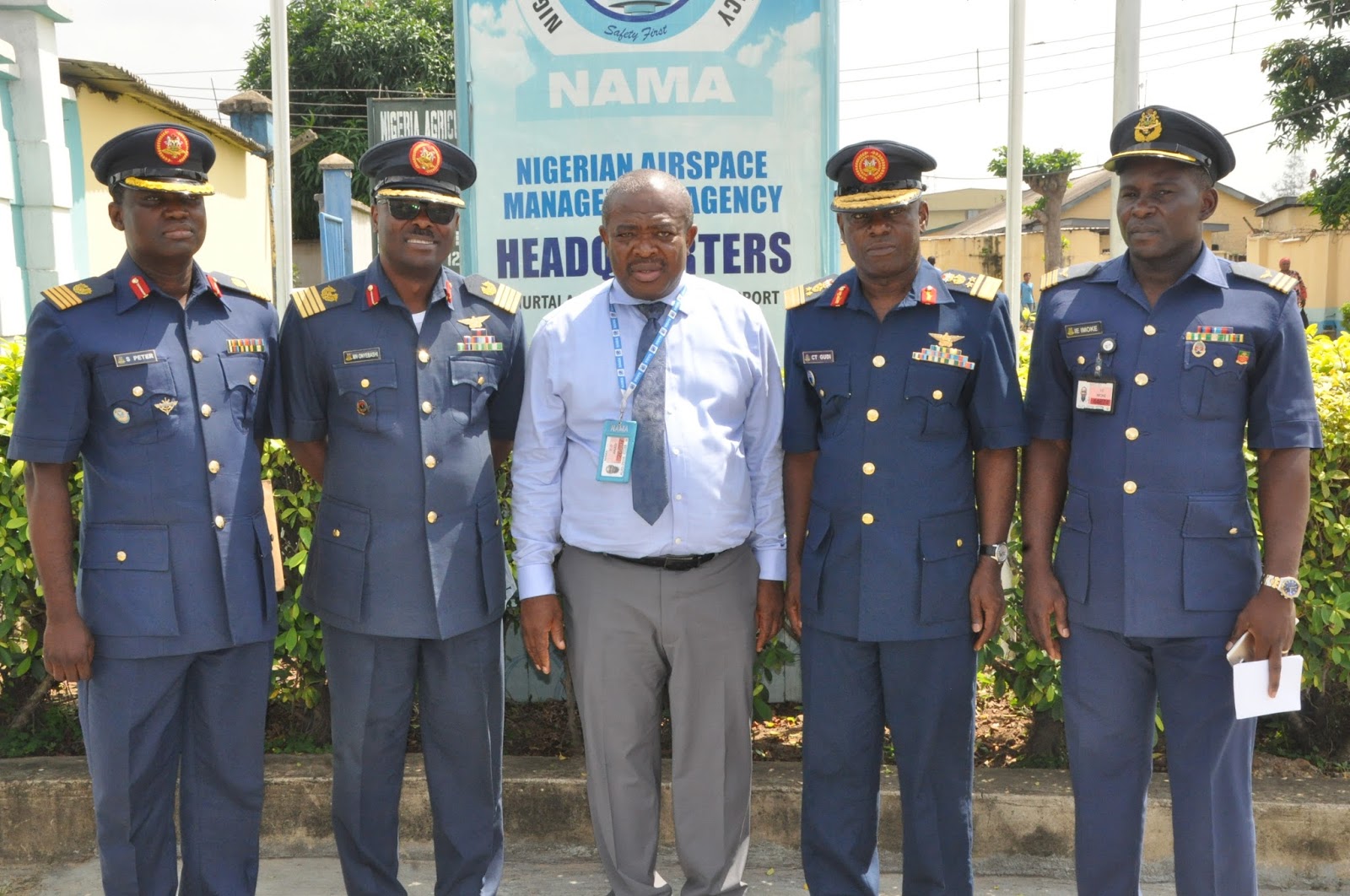
NAMA, NAF TO SYNERGIZE ON AIRSPACE SAFETY

 L-R: Dep. Director, Air Traffic Services,  Gp. Capt. S. Peter, Commander, Nigerian Air Defence Corps, GP. Capt. M. N. Onyebashi, Ag. NAMA MD, Engr. Emma Anasi, Director, Air Traffic Management Services,  AVM. Christopher Gudi and Military Airport Commandant, MMIA, Wg. Cdr. I. E. Imoke during a  visit of NAF team to NAMA hqtrs, Lagos recently.


The Nigerian Airspace Management Agency (NAMA) and the Nigerian Air Force (NAF) are working together to make the Nigerian airspace safer.  The two agencies have held high level deliberations bordering on collaboration and synergy of the two institutions in the areas of security of navigational infrastructure, calibration of navigational aids, training of personnel and exchange programmes. Speaking when he led a high-powered delegation on a courtesy visit to NAMA headquarters in Lagos, the Director of Air Traffic Management Services, Nigerian Air Force, AVM. C. T. Gudi noted that as a dependable ally, NAMA has always collaborated with NAF in critical areas like strategic airspace surveillance, air traffic control, airspace security and training of Air Force personnel. AVM. Gudi stated that the professional and technical expertise provided by NAMA in Air Force operations and training remained invaluable, stressing that their visit was therefore “to deepen this existing cordial relationship and operational synergy especially given the numerous benefits accruing to the nation in terms of safety and security of the airspace.” AVM Gudi who specifically appreciated NAMA for providing on-the-job training for Air Force personnel who graduate from the Nigerian College of Aviation Technology (NCAT) Zaria, also appealed to the agency to always consider the Air Force while planning for ad hoc trainings and seminars on Performance Based Navigation (PBN) and other such programmes which fall in between the major courses at NCAT, Zaria.  According to him, “the aviation world is very sophisticated and dynamic and is all about who has superior training. Given that NAMA is more acquainted with ICAO calendar and programmes, it has become imperative that the Nigerian Air Force be carried along in some of these trainings so that we can all be speaking the same language.” In his remarks, the Ag. Managing Director of NAMA, Engr. Emma Anasi stated that the complimentary role played by NAMA and NAF in ensuring safety and security of the airspace requires that a coordinated and harmonious civil/military collaboration has to be sustained and improved upon. While appreciating NAF for providing security around navigational facilities across the nation’s airports, Anasi called for uniformity of Communication, Navigation, Surveillance/Air Traffic Management (CNS/ATM) infrastructure between the two organizations which he believes will make for interoperability of systems and seamlessness in airspace management.

Wednesday, 8 June 2016

Dana Air Excites Frequent Flyers


….Wins City Peoples’ Airline of the year Award

L - R: Communications Manager Dana Air, Kingsley Ezenwa, Caroline Adeneye, and Ogun state Commissioner for Information and Strategy, Mr. Dayo Adeneye, during the presentation of City Peoples' Airline of the Year Award to Dana Air recently.


Dana Air has announced that frequent flyers on its entire route network – Lagos, Abuja, Port Harcourt, Uyo and Accra, will earn double Miles when they register for its frequent flyer program and book their tickets before 18th of June, for travel from 1st till 30th of June, 2016. 

According to the airline,  frequent flyers will earn double miles based on their class of tickets while registered members of its frequent flyer program, stand a chance of getting a spot upgrade to business class, whenever they fly economy this June.

The Accountable Manager of Dana Air, Mr Obi Mbanuzuo, said the airline is considering more offers to make this summer exciting for its guests. ‘’ We understand what the travel desire of our guests will be in the months to come and we are reviewing with the objective to offer more exciting packages and rewards to our guests.’’ He said the essence of the spot upgrade is for members of Dana Miles to experience the world-class hospitality that typifies its Business Class cabin.

Meanwhile, the airline has received another laurel having been recognized as Airline of the Year at the 19th edition of the City People Awards for Excellence, held on May 29th at The Lekki Coliseum, Lagos.

According to the Publisher and Editor – in- Chief of City People Media Group, Mr Seye Kehinde, “The City People Awards for Excellence, is an annual event meant to reward and celebrate deserving personalities and corporate organizations that excelled in their various areas of endeavor.'' He said Dana Air  emerged winners for doing well in the aviation sector.

Commenting on the award, The Accountable Manager of Dana Air, Mr Obi Mbanuzuo, said, ‘’we are honored to have received this award and are happy that our efforts in providing quality customer and in-flight service to our esteemed guests is being recognized.  We put our customers first in all we do and some of the online platforms recently  launched are just our way of ensuring constant touch with our customers when they have enquiries, feedback or need updates on their Dana Miles account.” Obi said the airline remains fully committed to its vision which is to be recognized and respected as Nigeria’s most reliable and customer-friendly airline.


Only recently, Dana Air bagged an award for service excellence in aviation at the 2016 Commerce and Industry Awards, organized by the Lagos Chamber of Commerce and Industry.

Extreme Weather Threatens Food Security - Anuforom


The Director General, Nigerian Meteorological Agency (NiMet), Dr. Anthony Anuforom has declared that extreme weather events such as drought, flood and heat waves constitute a serious threat to food security at both the household, community, regional, national and global levels.

Dr. Anuforom who made the declaration Tuesday as Guest Lecturer at the 10th Annual Lecture Series of the Faculty of Environmental Sciences, Nnamdi Azikilwe University, Awka, said the threat is as a result of the high vulnerability of agricultural production to weather variabilities.

Speaking on the theme,  "The Impact of Extreme Weather Events on Food Security in Nigeria", Anuforom said that throughout history, the search for food has been the most fundamental human activity, and has influenced human behavior and activities. He however regretted that man's quest for food security has continued to be hampered by extreme weather events.

He said in Nigeria, agriculture is predominantly rain-fed system and therefore highly vulnerable to rainfall extremes, adding that recurrent droughts since the 1960s, "particularly those of the 1970s and 1980s, have been a great challenge to agricultural production and food security in the country".

Flooding, which he noted is at the opposite extreme end of the spectrum of rainfall, is as devastating and detrimental to the quest for food security as drought. He said: "In 2012 Nigeria experienced one of the most devastating flooding on record. The floods destroyed farmlands and other means of livelihood of many households and killed very large numbers of livestock in the affected areas.

"The floods also destroyed roads, bridges and other infrastructure. The cumulative effect was a decrease in the availability as well as economic and physical access to food in the affected areas". The good news however, according to the DG is that the impact of extreme weather events on food security in Nigeria can be managed through "climate change adaptation policies and appropriate economic framework by government".

He further stated that weather forecast and climate predictions, such as NiMet's Seasonal Rainfall Prediction (SRP), as well as other meteorological Early Warning Products "are useful tools for reducing vulnerability of agriculture and food security to extreme weather events" in the country.

Anuforom said in view of the fact that food insecurity could create the atmosphere for, and even fuel Socio-political instability, policies and programmes for ensuring adequate food for citizens are usually priorities of governments all over the world, and commended the present administration's effort in this direction.

"With regard to economic policy framework, the present federal government, through the Ministry of Agriculture & Rural Development, has stated that agriculture extension service will be strengthened as part of the strategies to improve agricultural yield and food security in the country. This is obviously a laudable policy direction", the DG declared, stressing:

"To achieve better results from this policy, agro-meteorological information and weather forecasts should be incorporated as part of the agricultural extension package given to farmers; alongside improved seeds, fertilizers, tractors and other physical items. This will enable farmers to better manage risks associated with weather extremes", he opined.

In his Welcome address, the Dean, Faculty of Environmental Sciences, Prof. Joel I. Igbokwe said a nation's development is largely measured on the ability of that nation to feed her population and guaranty food security for her people at all times, stressing that extreme weather events can however reduce the ability of any nation to feed her people if not well monitored and controlled.

He said all over the world, there is a growing concern that these extreme weather events will have the very negative impact on global food production, adding that if not properly monitored, managed and controlled could drastically reduce the ability of poorer and developing countries, including Nigeria to produce regular crops for their population.

Describing the timing and theme of this year's annual lecture as very apt, the Dean further observed that severe shortage in food production will expose people living in the developing countries to political and economic instability and conflicts. "It is this concern that motivated us to select this topic for our annual lecture", he emphasized.